Nail Pop Repair
Round blisters and raised screw heads, reset with new fasteners and covered so they stay put.
(980) 577-1280Call 7 days, 7am–9pm
Walls and ceilings, Matthews, NC
Popped nails, cracked seams, dented corners, holes and water-stained ceilings, repaired with the dust contained and the texture blended so the fix vanishes under paint.
After you call, a drywall pro from the Matthews area gets in touch to look over the damage and put a number on it.
Call 7 days, 7am–9pm
Nothing gets cut, sanded or patched until you have agreed to a price.
The 1980 census found 1,648 people in Matthews; the 1990 count was 13,651 and by 2000 it topped 22,000. Most of the town's 12,000-plus homes went up during that stretch, and houses of that age tend to show the same few drywall habits.
Framing lumber keeps drying for a good while after a house is finished. As studs and joists shrink, nails and screws are left standing proud and push a round blister through the paint. Taped seams over long walls and stairwells open into straight hairlines. Where roof trusses span a room, the ceiling can lift a little in winter and pull a crack along the top of a wall, then close again in summer.
None of this usually means the house is in trouble. It does mean a repair has to allow for movement. That is why a popped fastener is fixed by setting a new screw beside it, and why a seasonal ceiling crack is finished differently from an ordinary seam.
A single popped nail, a picture-hook hole or a dent the size of a coin can be filled with lightweight spackle, sanded with a fine sponge and touched up. That is a sensible afternoon job.
Things change once the damage is bigger than your palm, runs along a seam, sits on a corner, or involves water. Those need tape or a backed patch, several coats that each have to dry, and texture that blends into the wall. Before you cut into any wall, shut off the circuit for nearby outlets and switches and think about what runs behind it. In a house built before 1978, test the paint for lead before sanding.
Read the full patch-it-yourself guide, with tools and warning signs
Other reading lives with the drywall care guides.
Each repair below has its own page covering causes, method and the worries that come up before booking.
Round blisters and raised screw heads, reset with new fasteners and covered so they stay put.
Hairlines at seams, door corners and ceiling lines, re-taped and feathered instead of just filled.
Dented, cracked or loose outside corners, cut back and rebuilt with new bead.
Doorknob holes, furniture dings and anchor tears, patched with backing and blended texture.
Stains, soft board and sagging ceiling sections, opened up once the plumbing or roof is put right and the board has dried.
Joint compound is more porous than the painted wall around it. Paint straight over a patch and it soaks in differently, so the spot reads flat or shiny when light rakes across it. Painters call that flashing. The cure is primer over every bit of new compound, then a finish coat that runs out to a corner or a natural break instead of a dab over the patch.
Texture matters as much as primer. A smooth patch in the middle of an orange peel wall is obvious from the doorway, and a ceiling patch left flat stands out under any light fixture. The texture is sprayed or hand-applied to blend the edges before priming.
Who paints is up to you. Some people keep leftover paint and do the final coat; others want the wall handed back painted. If the can is long gone, a chip cut from behind a switch plate can be mixed to match at a paint store. Match the sheen too: an eggshell patch on a flat wall will show.
Plain expectations for the day of the work. Exact timing turns on how big the repair is and on the weather, because humid days slow drying.
If anything about the repair looks different from what was described in the quote, the pro explains it before going further. You decide. There is more on how the work is arranged from first call to primed wall.
A few nail pops, anchor holes or a short hairline. Often one visit, thin coats, spot primer.
A doorknob hole, a crushed corner, several feet of seam. Backing or new bead, three coats, and commonly a return visit for texture and primer.
A water-damaged ceiling section or a cut-out wider than a stud bay. New board fastened to the framing, taping, several coats, texture across a wide area and often paint for the whole ceiling.
Price follows the work, not a menu. The things that move it are size and number of spots, whether new board or bead is needed, the texture, ceiling height and ladder setup, how much of the room needs protecting, drying time that forces a second visit, and if you want the area painted. The figure is set after a local pro has seen the wall, and you hear it before any work starts.
| What you see | Usual cause | Where to read more |
|---|---|---|
| A round bump or ring over a screw line | A fastener backing out as framing dries | Resetting popped nails |
| A straight hairline along a joint | Tape that let go, or a joint over framing that shifts | Seam crack repair |
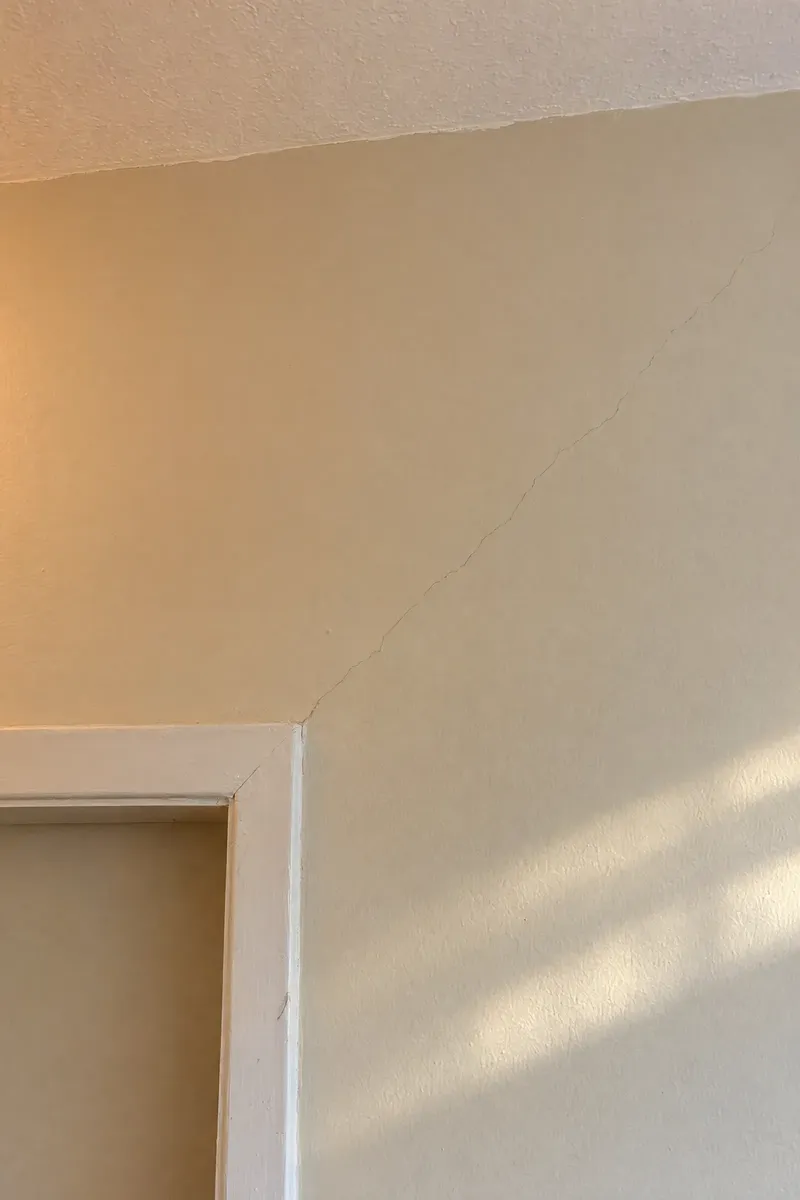
| A diagonal crack off a door or window corner | Stress at the opening as the house settles | Fixing diagonal cracks |
| A crack where ceiling meets wall, worse in winter | Truss uplift, the ceiling moving with the seasons | Ceiling notes below |
| A dented, split or loose outside corner | Impact on the corner bead | Corner repairs |
| A ragged hole or a crushed dent | A doorknob, furniture or a pulled anchor | Hole patching |
| A brown ring, soft spot or sag | Water from above or behind | Water-damaged drywall |
Before a move-out inspection, a sale or listing photos, the repairs that matter are the ones a camera or an inspector notices: holes from TV mounts and shelf anchors, doorknob holes, crushed corners in hallways and any water stain on a ceiling. A stain in particular raises questions, so it is worth having the source checked and the board repaired rather than painted over.
Small picture-nail holes are often treated as normal wear, but check your lease rather than guessing. Schedule the drywall work first and the painters after, with a gap for compound to dry fully; in humid summer weather that gap is longer. Ask for the patches to be primed, so the painters start on a sealed surface.
Matthews sits in southeastern Mecklenburg County, about 11 miles from uptown Charlotte. Repairs are arranged in the town and in the places around it:
Tell us what you are seeing. A photo of the damage, plus one from further back to show the room, makes the first conversation much more useful.
One call starts it: the pro who would do the repair rings you back to look at the wall and put a figure on it.
Call 7 days, 7am–9pm
What follows is a call from the pro who would take the job; you go over the damage together and settle a price first.